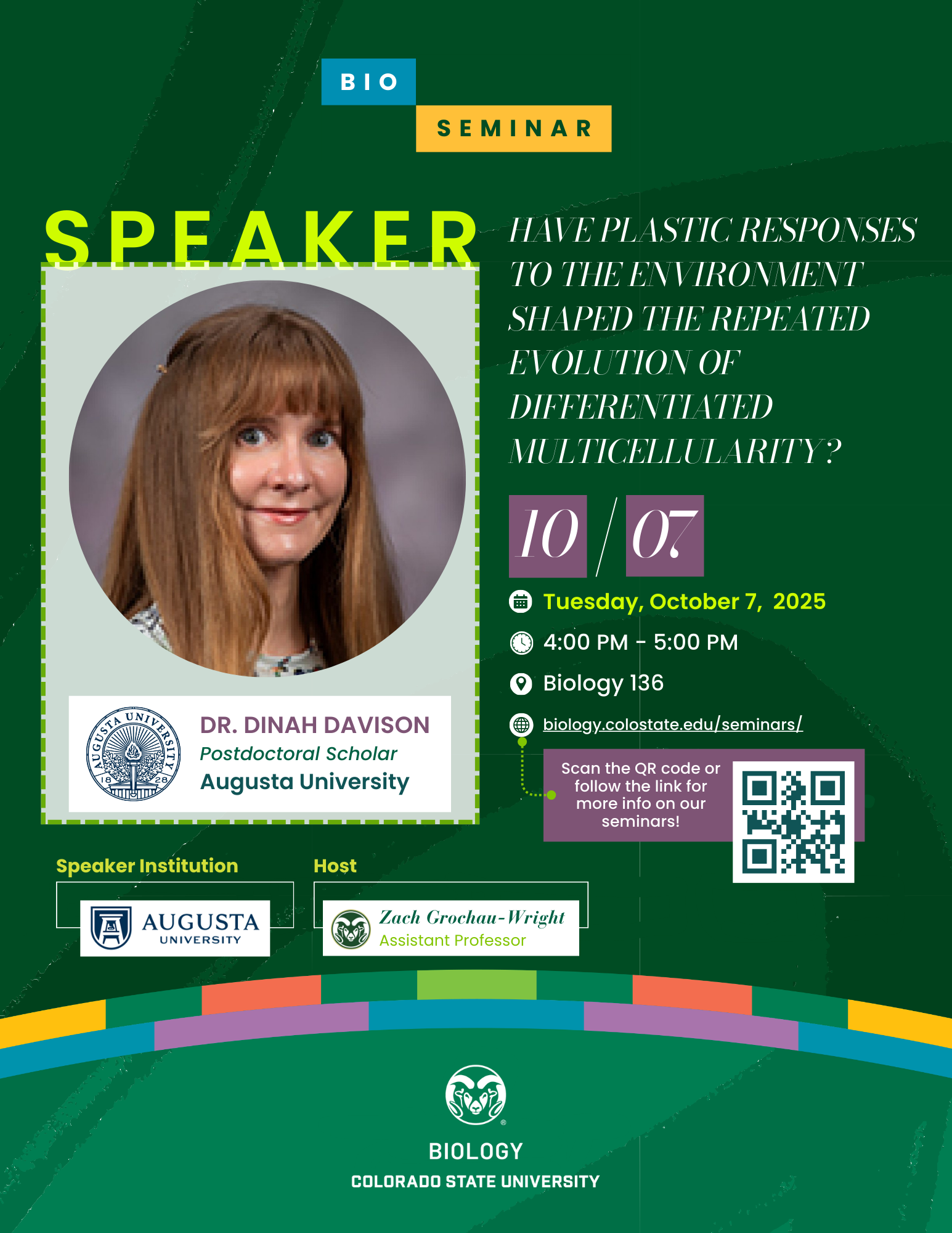
You’re invited! Join us for a thought-provoking seminar hosted by the Biology Department at Colorado State University. Dr. Dinah Davison, Postdoctoral Scholar at Augusta University, will present “Have Plastic Responses to the Environment Shaped the Repeated Evolution of Differentiated Multicellularity?”
Explore how environmental factors may drive the evolution of multicellular complexity.
- Date: Tuesday, October 7, 2025
- Time: 4:00 PM – 5:00 PM
- Location: Biology Room 136
Visit our website for more information on our seminars and follow us on social media for more announcements from Biology.
- Instagram: @csubio
- Twitter/X: @csubiology
- Facebook: Department of Biology at Colorado State University
Abstract
The transition to multicellularity has occurred repeatedly across the tree of life, giving rise to diversity of complex life we see today. Multicellularity has evolved dozens of times within the green algae alone. We examine whether this repeated transition may have been facilitated by plastic responses to the environment that were later stabilized by developmental-genetic changes. We use the volvocine green algae as a model system and focus on two key stages in the transition to multicellular organization: group formation and cellular specialization. We examine facultative group formation in response to the presence of predators in Chlamydomonas reinhardtii, a unicellular species that is closely related to multicellular volvocine algae. We identify molecular mechanisms regulating aggregative group formation in Chlamydomonas and propose that the evolution of multicellularity in the green algae may have involved the co-option of these mechanisms.
Next, we examine a multicellular volvocine algae species, Eudorina, which has been historically characterized as undifferentiated but can develop a small proportion of plastic somatic cells following exposure to cold shock. We exposed Eudorina cultures to repeated cold shock and characterized the differentiation status of our lines more than 30 generations after the cessation of the cold treatment. We found that differentiation evolved rapidly, with all lines showing changes in the regulation of somatic cell development and two lines evolving obligate somatic cells. We characterized the selection dynamics that shaped this rapid evolution and found that colonies with somatic cells were more likely to survive cold shock. Our results demonstrate that selection can rapidly drive the repeated transition to differentiated multicellularity via the stabilization of a plastic response.