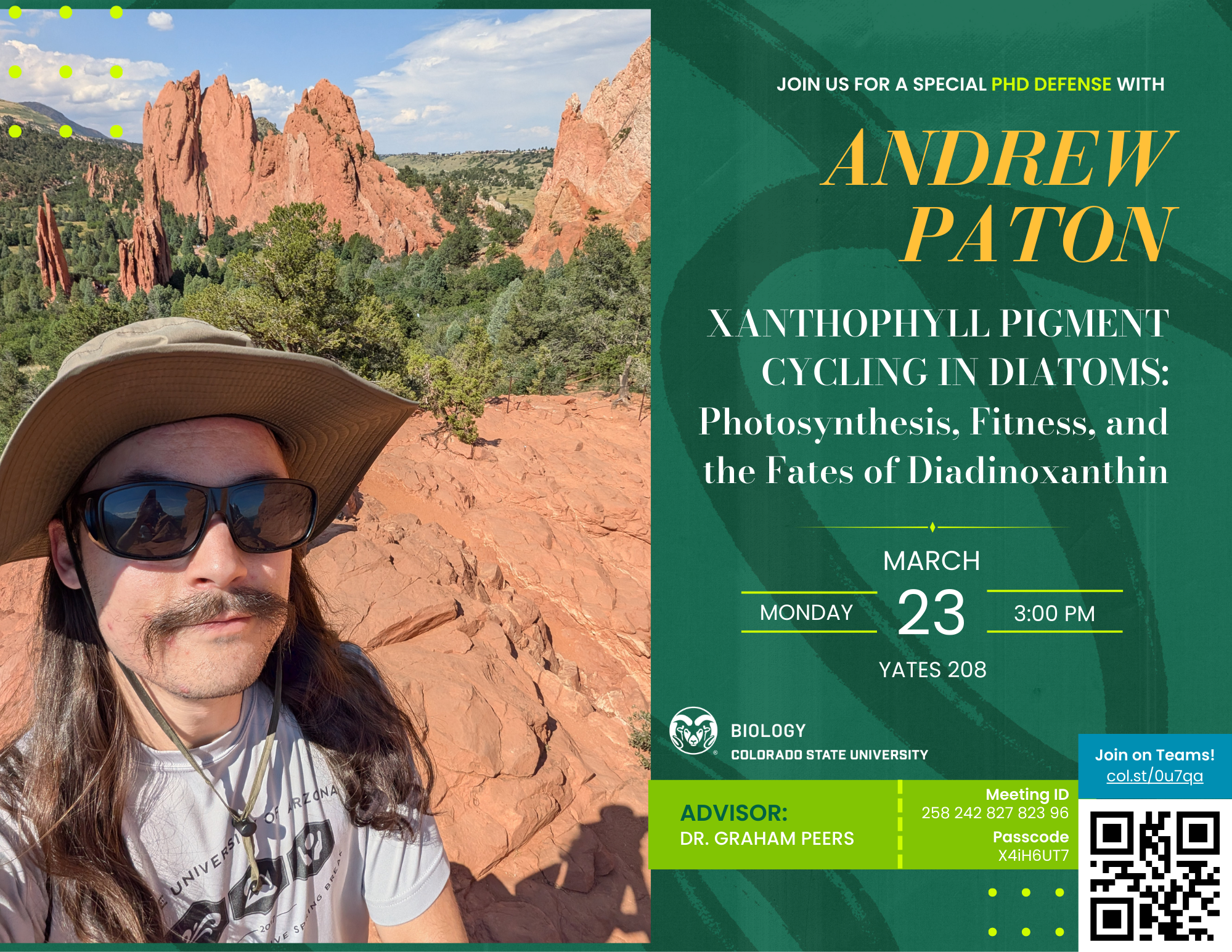
Please join us for a special PhD Defense Seminar with PhD candidate and CSU Biology grad student, Andrew Paton, entitled, “Xanthophyll Pigment Cycling in Diatoms: Photosynthesis, Fitness, and the Fates of Diadinoxanthin”. Andrew’s seminar explores how diatoms manage light using a unique set of pigments that help them both capture energy and protect themselves from too much sunlight. His research identifies the key genes that control this pigment cycle and shows how diatom photosynthesis and carbon storage change when those genes are missing. Andrew’s work offers new insight into why diatoms are so successful in nature and highlights potential genetic targets to improve their performance in industrial settings.
Event Details:
Speaker: Andrew Paton
Title: Xanthophyll Pigment Cycling in Diatoms: Photosynthesis, Fitness, and the Fates of Diadinoxanthin
Date: Monday, March 23, 2026
Time: 3:00 PM
Location: Yates 208
-
Meeting ID: 258 242 827 823 96
-
Passcode: X4iH6UT7
Advisor: Dr. Graham Peers, Associate Professor, CSU Department of Biology
Whether you’re into ecology, photosynthesis, or innovative bioengineering, this seminar is a great opportunity to learn how diatoms’ unique light‑management tricks can drive both scientific insight and industrial innovation.
We look forward to seeing you there in support of this incredible milestone!
Abstract
“Diatoms are microalgae that are abundant across the globe, produce around 20% of atmospheric oxygen, and are increasingly relevant to industry for lipid and antioxidant production. Through a separate evolutionary history from plants, diatoms possess several distinct photosynthetic pigments. As photosynthetic organisms, diatoms must balance harvesting enough light for photochemistry and dissipating harmful excess light. Diatoms primarily accomplish this via a toggle switch between carotenoid pigments called the xanthophyll cycle, which utilizes different pigments than the comparable plant cycle. The genes catalyzing this cycle in diatoms had not been fully characterized. For my dissertation, I sought to identify these genes and characterize pigment content, photosynthetic physiology, and fitness in their absence. In my first two sections, I show evidence that two diatom genes related to corresponding plant genes complete their xanthophyll cycle. In another section I directly compare the photosynthesis and organic carbon accumulation of the mutants of the two involved genes. I finish by presenting some data on a spontaneous lab mutation potentially mirroring how the biosynthetic pathways for these pigments naturally evolved. These findings further our understanding of how diatoms achieved ecological success and provide engineering targets for improving performance in dense industrial culture, where competition between light harvesting and dissipation lowers productivity.”