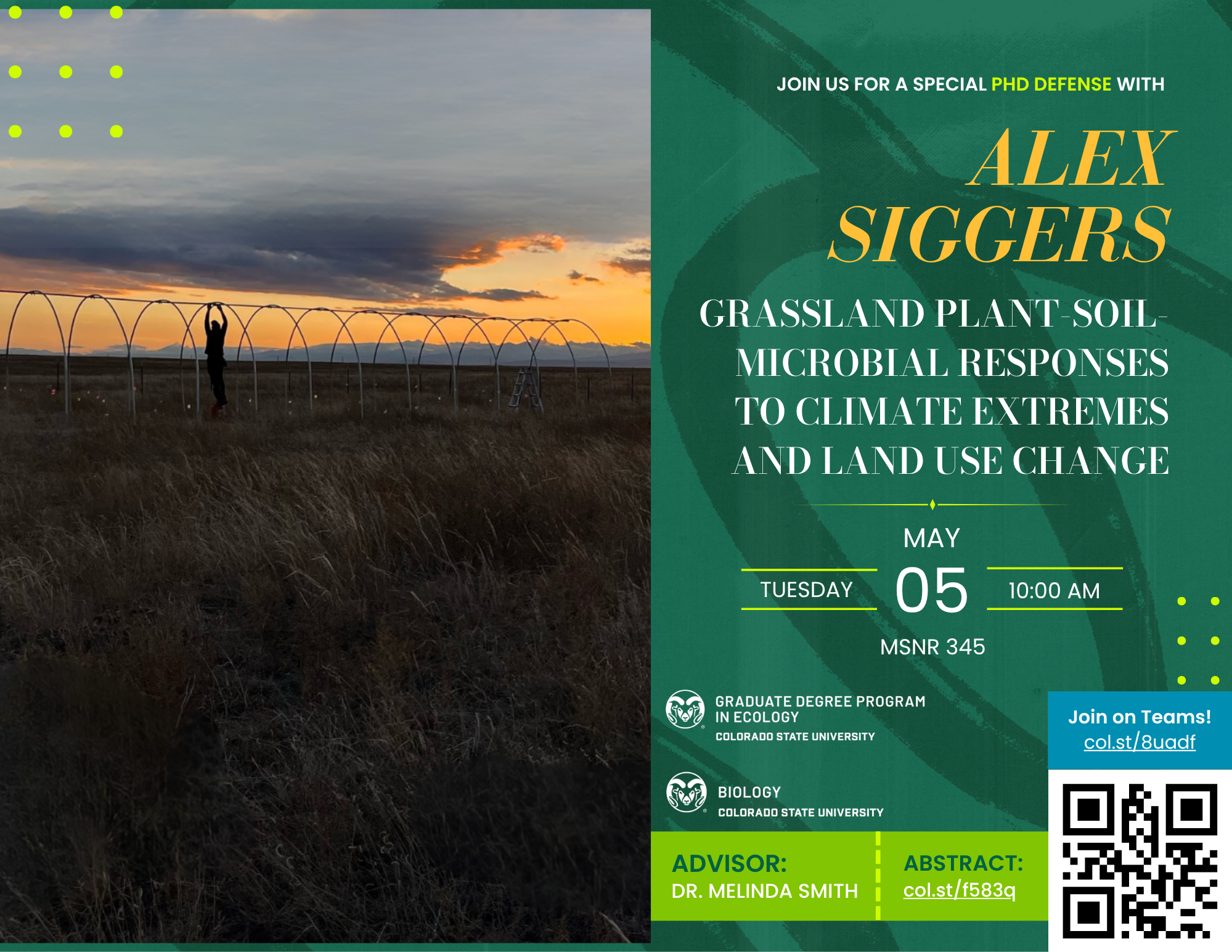
You’re invited! Join us for Alex Siggers’ PhD Seminar Defense entitled, “Grassland Plant-Soil-Microbial Responses to Climate Extremes and Land Use Change”. This seminar will focus on how global change drivers, such as extreme droughts, deluges, and renewable energy development, are impacting grassland ecosystems across the United States Great Plains. Celebrate his achievement and explore this critical and thought-provoking work!
This seminar offers a unique opportunity to examine how hydroclimatic extremes and land use changes are altering ecosystem structure and function. Alex’s research highlights the pressing need to better understand the legacy effects of these changes before ecosystems are irreversibly transformed.
Event Details
Speaker: Alex Siggers
Title: Grassland Plant-Soil-Microbial Responses to Climate Extremes and Land Use Change
Date: Tuesday, May 5th, 2026
Time: 10:00 AM
Location: MSNR 345
Advised by Dr. Melinda Smith, Professor and Vice provost for Faculty Affairs, CSU Department of Biology
Can’t make it in person? Join online!
Teams: col.st/8uadf
Alex’s dissertation investigates how extreme droughts, deluges, and solar photovoltaic energy development are altering abiotic determinants of ecosystem functionality. His work provides critical insights into how these global change drivers impact grassland ecosystems, emphasizing the need for a deeper understanding of these ecosystems before lasting changes occur.
Join us in celebrating Alex’s achievement and explore his critical and thought-provoking work!
-
Instagram: @csubio
-
Twitter/X: @csubiology
Abstract
Atmospheric warming is intensifying the global hydrological cycle, leading to increased occurrence of hydroclimatic extremes. Extreme droughts and deluges (persistent, torrential rain events) are already impacting ecosystems globally, with each leaving legacy effects of altered ecosystem structure and function. The likelihood of co-occurring hydroclimatic extremes increases with each degree of warming, yet little is known about how compound drought and deluge events impact ecosystems. Similarly, climate solutions, such as renewable energy development, are altering abiotic determinants of ecosystem functionality. Solar photovoltaic energy (PV) is currently the cheapest, most scalable renewable energy option, though PV arrays occupy greater land area than alternative energy forms and may have unintended consequences for their host ecosystems. Thus, precipitation inputs and other abiotic factors are being altered by global change drivers in myriad ways, yet experimental assessments of their ecological impacts are limited and highly context dependent. Further, altered precipitation regimes and land use changes are likely to be especially consequential in grasslands, where water is the predominant limiting resource and PV deployment is most expansive. In this dissertation I investigated how these global change drivers impacted grassland ecosystems across the United States Great Plains. The first chapter examined the legacy effects of extreme drought on soil microbial communities across representative grassland types of the US Great Plains. The second chapter shifted focus to the shortgrass steppe of northeastern Colorado, where I investigated the ecosystem impacts of compounded extreme drought and deluge. The final chapter assessed plant-soil-microbial responses to a PV array in a semi-arid C3 grassland. Altogether, this work suggests that global change drivers will have immense contemporaneous and lasting impacts on grassland ecosystems, highlighting the pressing need to understand our ecosystems before they are irreversibly altered.