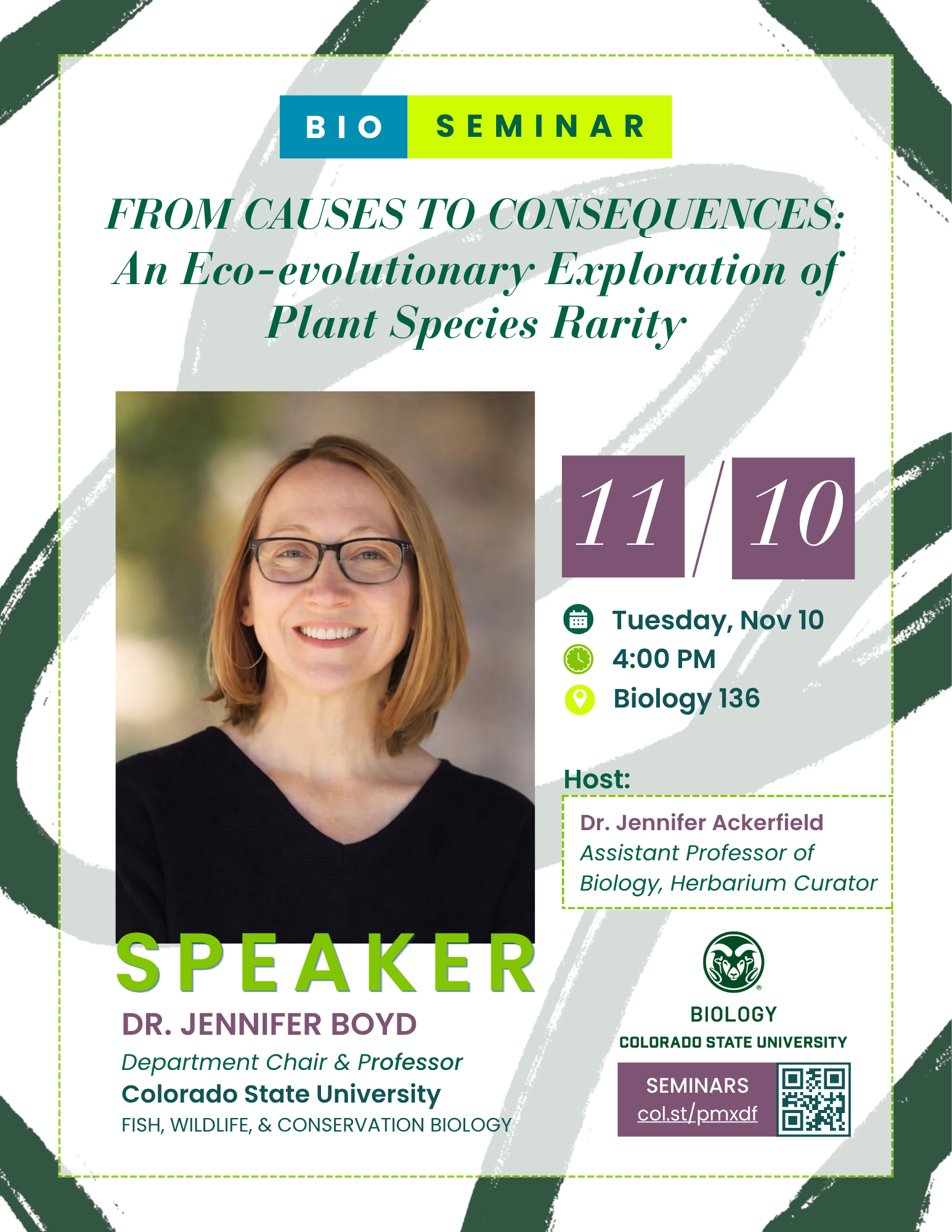
Join the Department of Biology in welcoming guest speaker, Dr. Jennifer Boyd, Department Chair and Professor in Fish, Wildlife, and Conservation Biology at Colorado State University, for a BIO Seminar.
Dr. Boyd will present “From Causes to Consequences: An Eco-evolutionary Exploration of Plant Species Rarity,” a talk that examines why some species are rare while others are common and what that means for conservation in a rapidly changing world. Drawing from research on rare endemic plant species in the southeastern United States, the seminar will explore how species respond to variation in light, water, and temperature, and why those responses matter for predicting vulnerability under future climate change.
The talk highlights the importance of considering multiple dimensions of environmental response when assessing species resilience, adaptation, and long-term conservation needs.
Event Details
Speaker: Dr. Jennifer Boyd
Title: From Causes to Consequences: An Eco-evolutionary Exploration of Plant Species Rarity
Date: Tuesday, November 10
Time: 4:00 PM
Location: Biology 136
Hosted by Dr. Jennifer Ackerfield, Assistant Professor of Biology and Herbarium Curator
We invite all students, faculty, and staff to join us for this free event.
Light refreshments available while supplies last.
Visit our website for more information on our seminars and follow us on social media for more announcements from Biology.
-
Instagram: @csubio
-
Twitter/X: @csubiology
Abstract
The enduring question of why some species are rare while others are common has important implications for the conservation of species and overall biodiversity. As environmental conditions change at unprecedented rates due to human activities, species persistence will depend on their ability to shift distributions, adapt to novel selective pressures, and acclimate to changing environments. However, rare species can have limited capacity to adapt or migrate due to low genetic diversity and/or fitness as is suggested by previous research and our meta-analytic work. In contrast, the role of acclimation in contributing to species rarity and resilience has received comparatively less attention. To investigate the potential role of acclimatory capacity in species rarity, we assessed the phenotypic plasticity of rare endemic plant species from the southeastern United States relative to that of congeneric widespread species. Contrary to expectations, rare endemic species generally exhibited levels of phenotypic plasticity in response to light and water variation that were comparable to, and in some cases greater than, those of their widespread relatives. However, rare species showed more limited responses to temperature variation, suggesting potential constraints under future climate change scenarios. Collectively, our results highlight the importance of considering multiple dimensions of environmental responses and their ‘real world’ context when assessing the vulnerability and conservation needs of rare endemic species in a rapidly changing world.