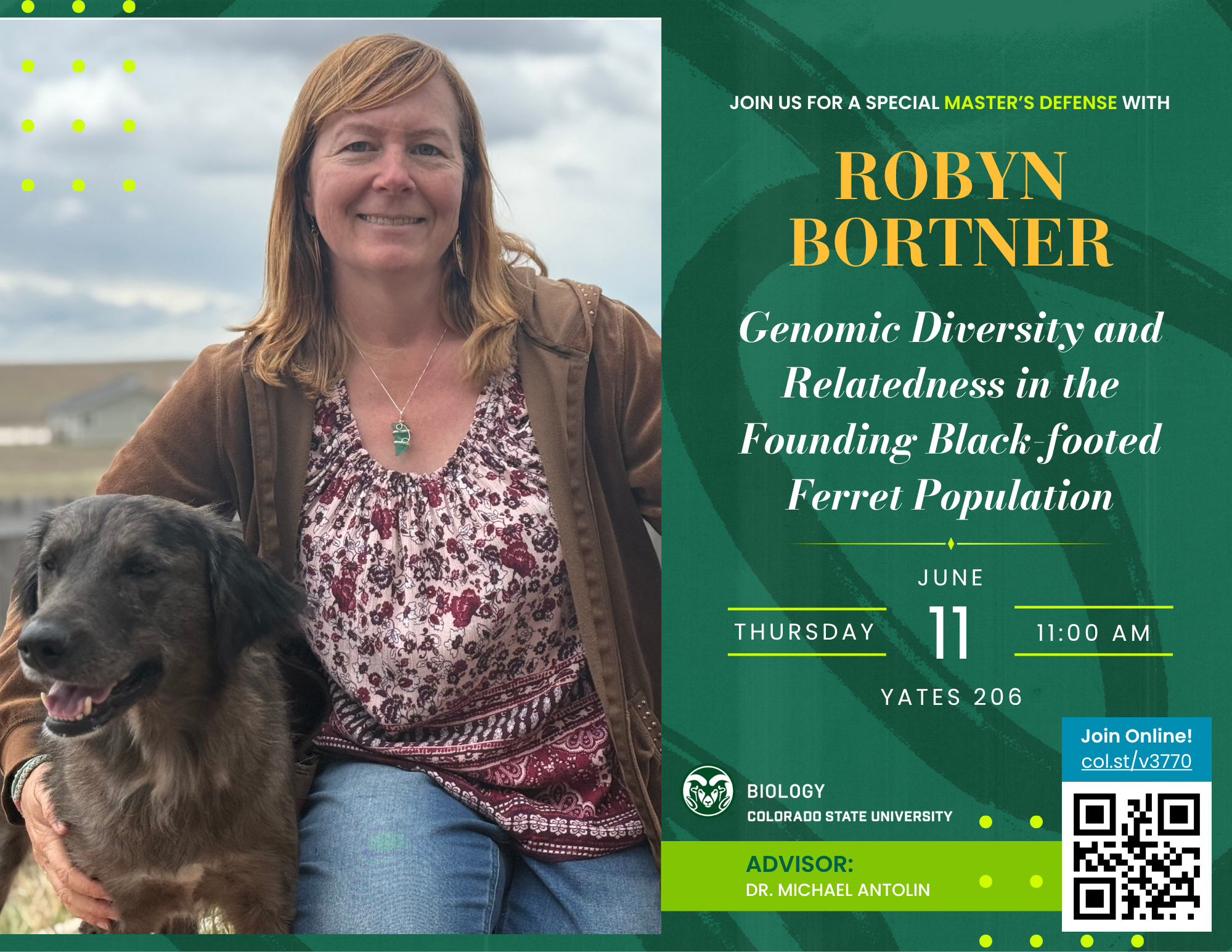
Join Us for Robyn Bortner’s Master’s Defense Seminar!
The Department of Biology at Colorado State University is excited to invite you to a special Master’s defense seminar presented by graduate student Robyn Bortner.
The black-footed ferret is one of North America’s most endangered mammals. In her defense, Robyn will explore the genomic diversity and relatedness of the founding population of this iconic species. Her research sheds light on the genetic challenges faced by conservation efforts and provides insights into preserving biodiversity.
Event Details
Speaker: Robyn Bortner
Title: Genomic Diversity and Relatedness in the Founding Black-footed Ferret Population
Date: Thursday, June 11
Time: 11:00 AM
Location: Yates 206
Can’t make it in person? Join us on Teams!
col.st/v3770
Advised by Dr. Michael Antolin, Emeritus Professor & former Department Chair, CSU Department of Biology
Whether you’re passionate about wildlife conservation, genetics, or ecology, this seminar is a must-attend event for anyone interested in the natural sciences. Don’t miss this opportunity to learn more about the intersection of genomics and conservation biology. We hope to see you there!
-
Instagram: @csubio
-
Twitter/X: @csubiology
Abstract
Black-footed ferrets (Mustela nigripes) are small obligate carnivores native to North American prairie ecosystems. They have the unfortunate but notable distinction of being assumed extinct twice in their history. Dependent on healthy prairie dog (Cynomys spp.) colonies for both food and shelter, black-footed ferrets most likely declined in response to prairie habitat loss and fragmentation, prairie dog eradication programs, and non-native disease, most notably sylvatic plague (Yersinia pestis). After their rediscovery at a single site in Wyoming in 1981, a successful captive-breeding and reintroduction effort was formed with the last 18 living individuals. Of these, only 7 are considered to be genetic founders of the extant population. Coupled with the population’s isolated nature on the far western edge of the species range, the founding black-footed ferrets had likely experienced a severe genetic bottleneck. Genetic management of the captive breeding population has been largely achieved through pedigree analysis. Although studied prior to capture, the relatedness of the founders is based on assumptions as they were all wild-caught, and paternity in particular can be uncertain. The founders are also considered to be unrelated individuals, but as they were all captured from the same dwindling source population, their relationships to each other are likely more complicated than studbook assumptions suggest. Fortunately, suitably preserved samples existed for 19 individuals of the source population, including the 7 assumed founders. For my research, I used next generation sequencing data and bioinformatics focused on variant discovery to characterize the amount of genomic variation in the founders, estimate levels of relatedness among the sampled individuals, infer relationships, and compare to the current pedigree. Results confirmed some relationships but contradicted others. Analysis also suggests that the founding population had a (not unexpected) higher level of background relatedness than is currently recorded. This work will inform further genetic investigation and conservation of the species.